Thermistor assembly selection: housing, IP rating and response
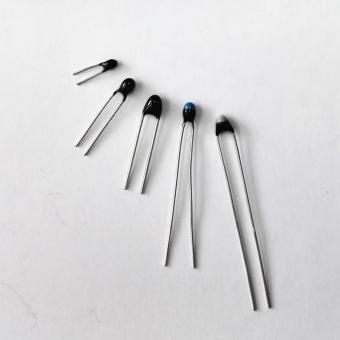
Sep 08, 2026A thermistor assembly is an NTC element packaged into a housing with leads so it can be fitted to a machine. The element decides the resistance curve. The housing decides almost everything else: how hot the assembly can go, how fast it reacts, whether it survives washdown, and how it mounts.
That is the part most selection goes wrong on. The same NTC chip in a silicone tube reaches +200 °C and takes about 60 seconds to settle in air. The same chip in a TPE overmould is rated IP67 and stops at +105 °C. Nothing about the thermistor changed.
Published 26 March 2025. Updated 10 September 2026. Reviewed by the Focusens technical department.
Two different jobs share this term. If you are replacing a thermistor in an LG refrigerator or a Whirlpool dryer, you need that appliance's service part number from the appliance maker or a parts distributor, and a generic assembly will not fit the connector or the bracket.
This page is about the other job: specifying a purpose-built assembly for a product you are designing or manufacturing, where you choose the element, the housing, the cable and the mounting.
Every housing is a trade. Sealing costs you temperature range. Temperature range costs you response speed. Speed costs you mechanical protection.
| Series | Encapsulation | Sealing | Temperature range | Response, water 0.4 m/s, T0.63 | Dielectric strength |
|---|---|---|---|---|---|
| MFE-1 | TPE or PVC overmould | IP67 standard, IP68 on request | −30 to +105 °C | 30 s | 1500 VAC |
| MFE-2 | Epoxy encapsulation | IP66 | −30 to +105 °C | 30 s | 1500 VAC |
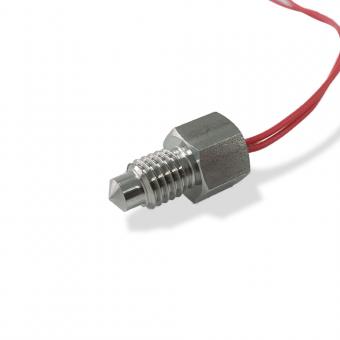
| MFT | Metal housing, SUS304 or SUS316, copper or plastic | waterproof, rating by build | −40 to +105 °C | ≤30 s | 1500 VAC |
| MFP-1 | Silicone rubber or Teflon tube | tube seal, no IP class quoted | −20 to +200 °C | ≤60 s in air | 1000 VAC |
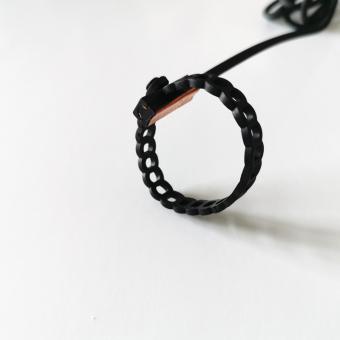
| MFP-2 | Ring lug, surface mounting with screw | contact mount, no IP class quoted | −30 to +150 °C | ≤30 s | 1500 VAC |
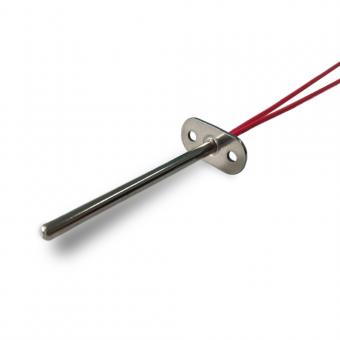
| FWZ (RTD) | Stainless sheath, PT100 / PT500 / PT1000 element | sheathed | −50 to +200, +350 or +600 °C by build | about 10 s at 0.63τ | per build |
Figures from the Focusens product catalogue. Insulation resistance is ≥100 MΩ at 500 VDC across the NTC series, and long-term stability is quoted as ≤3% drift after 1000 hours of heat or cold storage at 80 °C or −30 °C.

Rated ranges from the Focusens catalogue. The element is the same class of NTC across the five NTC series; the housing sets the ceiling.
Read the MFP-1 row against the others carefully, because the two numbers are not comparable. Its ≤60 s is measured in still air; every other row is measured in water flowing at 0.4 m/s.
Air carries heat away far more slowly than moving water, so the same assembly always looks slower in an air figure.
A response time without its medium and flow rate is not a specification, and comparing two suppliers' numbers taken in different media will mislead you every time. Ask which medium and what flow rate before you compare anything.
Start with the highest temperature the assembly will ever see, not the temperature you are measuring. A probe measuring 60 °C water inside an oven cavity lives at oven temperature.
That single number eliminates most of the table above. Above +105 °C the overmoulded and epoxy options are out, and you are choosing between a silicone or Teflon tube to +200 °C, a metal-sheathed build, or an RTD.
Then decide what it has to survive. The IP codes are defined in IEC 60529: IP67 is immersion to one metre for thirty minutes, IP68 is immersion beyond that to a condition agreed between supplier and buyer, and IP66 is powerful water jets but not immersion.
A dishwasher sump and a control cabinet are not the same problem, and IP68 without a stated depth and duration is an incomplete specification. Then check whether your response time is achievable. Thirty seconds to 63% in flowing water is normal for a sealed probe.
If your control loop needs to react in five seconds, no amount of housing selection will get you there and you need a smaller thermal mass, better contact, or a bare element.
Then pick the mounting. A ring lug bolted to a heat sink measures the heat sink. A threaded probe in a pipe measures the fluid, if it is immersed deep enough.
Surface mounting measures a surface and reports it slowly. Getting the mount right matters more than the last 5% of element accuracy, and it is covered in detail in thermistor mounting best practices.
Last, choose the element. R25 and B value affect your divider and your firmware, and they are the easiest thing to change late. How those two numbers behave, and why the same part can be labelled 3950 or 3988, is in the NTC thermistor guide.
A threaded probe screws into a boss or a fitting so the tip sits in the medium and the seal is made at the thread. It is the right answer for pipes, tanks, manifolds and anywhere the assembly has to be removable without opening the process.
Common thread forms on Focusens builds are M8×1, M12×1, M14×1, M16×1.5, G1/4 and G1/2, with SUS304 or SUS316 housings and PVC, XLPE or Teflon cable.
The thread is the wrong answer in three situations. When there is no boss to screw into and adding one means a pressure-vessel modification. When the medium is a solid surface, where a ring lug or a surface-mount pad makes contact the thread cannot.
And when immersion depth is too short, because a threaded probe that only just enters the flow reads a blend of fluid and fitting, and the fitting is closer to ambient than the fluid is.
A part number cannot be quoted from a temperature range alone. Six lines settle it.
| Line | What to state | Why it changes the build |
|---|---|---|
| Element | NTC with R25 and B value plus reference pair, or PT100 / PT500 / PT1000 with class | sets the curve and the tolerance |
| Maximum ambient | the hottest the whole assembly sees, not the measured medium | eliminates whole housing families |
| Sealing | IP66, IP67, IP68, or none, and the medium | decides overmould against epoxy against sheath |
| Mounting | threaded with the thread form, ring lug with the bolt size, surface, or free tip | drives the housing tooling |
| Cable | material, cross-section, length, and the ambient the cable sees | cable rating is often the real limit, not the tip |
| Termination | connector part number, or stripped and tinned | avoids a second operation on your line |
The cable line catches people out. A probe rated to +200 °C on a PVC cable is limited by the PVC, not the tip, so the ambient the cable runs through has to be stated separately from the ambient at the sensing end.
Across the NTC assembly series the catalogue quotes 1500 VAC dielectric strength, 1000 VAC on the MFP-1 silicone build, and insulation resistance of at least 100 MΩ measured at 500 VDC. Those are the figures to write into an incoming inspection specification.
If the assembly goes into equipment that carries a safety approval, the number in a catalogue is not sufficient evidence on its own.
Ask for the routine test record against a part code, which states the applied voltage, duration and pass threshold used in production. A supplier who tests every unit can produce it.
TPE overmoulded MFE-1 goes into refrigerators, water heaters, washing machines and dryers, where washdown and condensation are the risk and +105 °C is plenty. See the IP68 TPE overmoulded 5×20 mm probe and the flat 6×5×15 mm overmoulded variant where the space is shallow.
Epoxy MFE-2 goes into HVAC and ambient measurement where cost and size matter more than immersion. Metal-housed MFT goes into ice makers, heat pumps, water heaters and floor heating, with food-grade housing options.
Silicone and Teflon MFP-1 goes into rice cookers and induction cookers, where +200 °C is the requirement and a 60 second air response is acceptable. Ring-lug MFP-2 bolts to motors, heat sinks, projectors and lithium battery packs.
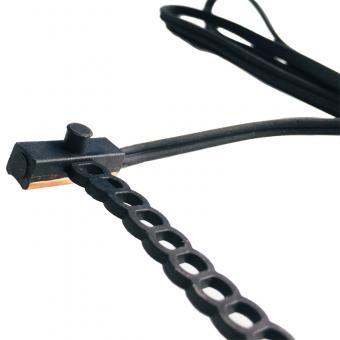
For battery work specifically, the glue-in battery pack probe is the lower-cost route where a bolt is not available, and PCB-mount TO-220 packages exist where the sensor sits on the board rather than on the machine.
The full range sits in the NTC thermistor sensor and probe category. If you have not yet chosen the output the assembly should deliver, probe temperature sensor output types covers analog against digital against transmitter builds.
No.1 XiSan Road, Electromechanical Industry Park , High&New Tech.Zone. Hefei,Anhui,China
tel : +86-551-69109668
Whatsapp : +86-13339100504
e-mail : info@focusens.com
Skype : melodyliu520






 +86-551-69109668